Friday, 29 July 2022

A Little Squeeze on the Side


Aside from painting some new figures and armies, I've been diddling about with some much older ones. My SYW Prussian army was painted around 14 or so years ago and the basing used hand cut cardboard squares with that old wood coloured flock. In short, I've been meaning to give them a touch up for some time. 


Here are half of my infantry (almost) complete. I say almost due to the fact I damaged one flag during un-basing and have not glued the unit name tags on the backs either. 


I'm very pleased with the result - just what I was going for. I was after a good standard for play rather than a 'internet professional' level of job (I'm not capable of that anyway.) Added to this, after two Prussian armies, I find getting Prussian blue 'right' quite difficult. Getting a good highlight is the hard part in my opinion. Something that looks good to the eye is simply too bright for the coats the soldiers wore. There is often a disconnect between what is seen as a good painting standard today and what things looked like in history. Any surviving coats were very dark. 


When I put them together it looks like such a small group - guess that will happen when my last LARGE painting project was two Napoleonic armies with a combined total of 1056 infantry, around 80 gunners (+cannon) and over 120 cavalry. 


Don't they look good in their ranks ... ready to march into the guns for Prussian glory!


Another side project was a single figure for my good friend, Mick. Fired by nostalgic zeal, Mick purchased Heroquest and we've had a few games. He decided the paint all the mini's and since I played the wizard - who I call 'Ronson' - he asked me to paint it up. The paint job was quite difficult as the miniature details were in very low relief. After base coating and some washes I thought I had muffed it - but perseverance paid off and I'm once again happy with the result. 


These other images are of a board I set up for a recent game of 'O' Group I played. This terrain has not seen the light of day for over 6-7 years - at the time I stopped playing FOW. 


As for 'O' Group ... what can I say. It is a typical Dan Brown set of rules ... painfully slow with dice rolls upon dice rolls deciding every factor of the game rather than player decision making. 

I find the 'Brown style' (evident in General de Brigade, Pickett's Charge and 'O' Group - all of which I've played) to be a good representative of an outdated method of writing rules.  


Lasalle 2 Wargame - Napoleonics Mustafa Style


The following images tell the tale of a game of Lasalle 2 ... backwards. 
This week's club game saw but two hardy gamers playing. Upon request, I ran my good friend Mick B through the Lasalle 2 introductory scenario. The only difference was that we played with exactly the same army - 8 infantry, 2 foot batteries, 2 light cavalry and 1 horse battery. 

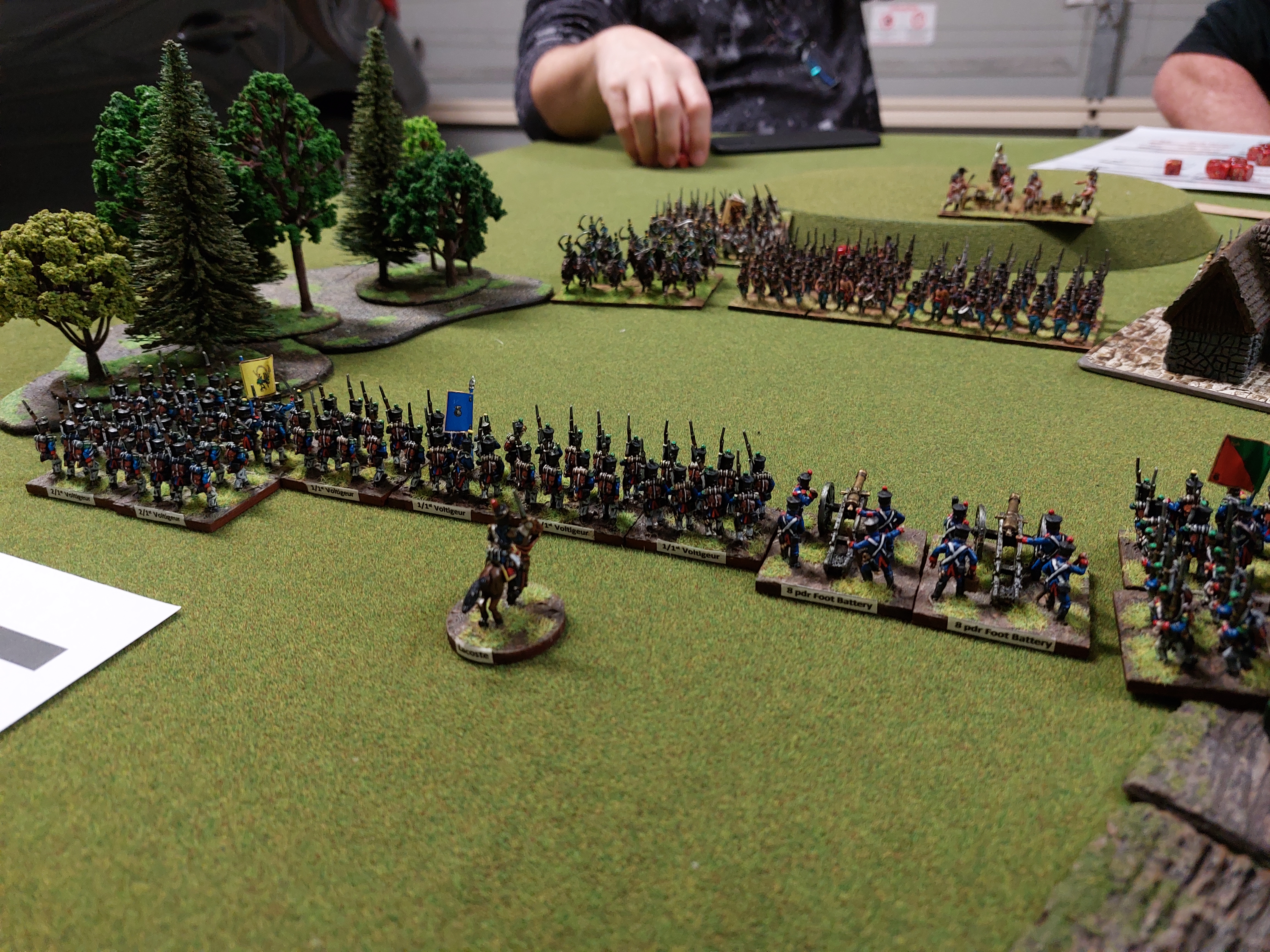
What followed was a great game which we both enjoyed very much. We played with the 3 unit sudden death victory condition. As the above image shows, the Prussians achieved victory on the French left wing. An entire Prussian infantry brigade flanked around the forest and struck the French a fatal blow. When the charge finally drove home, three units were lost in a single combat phase. 


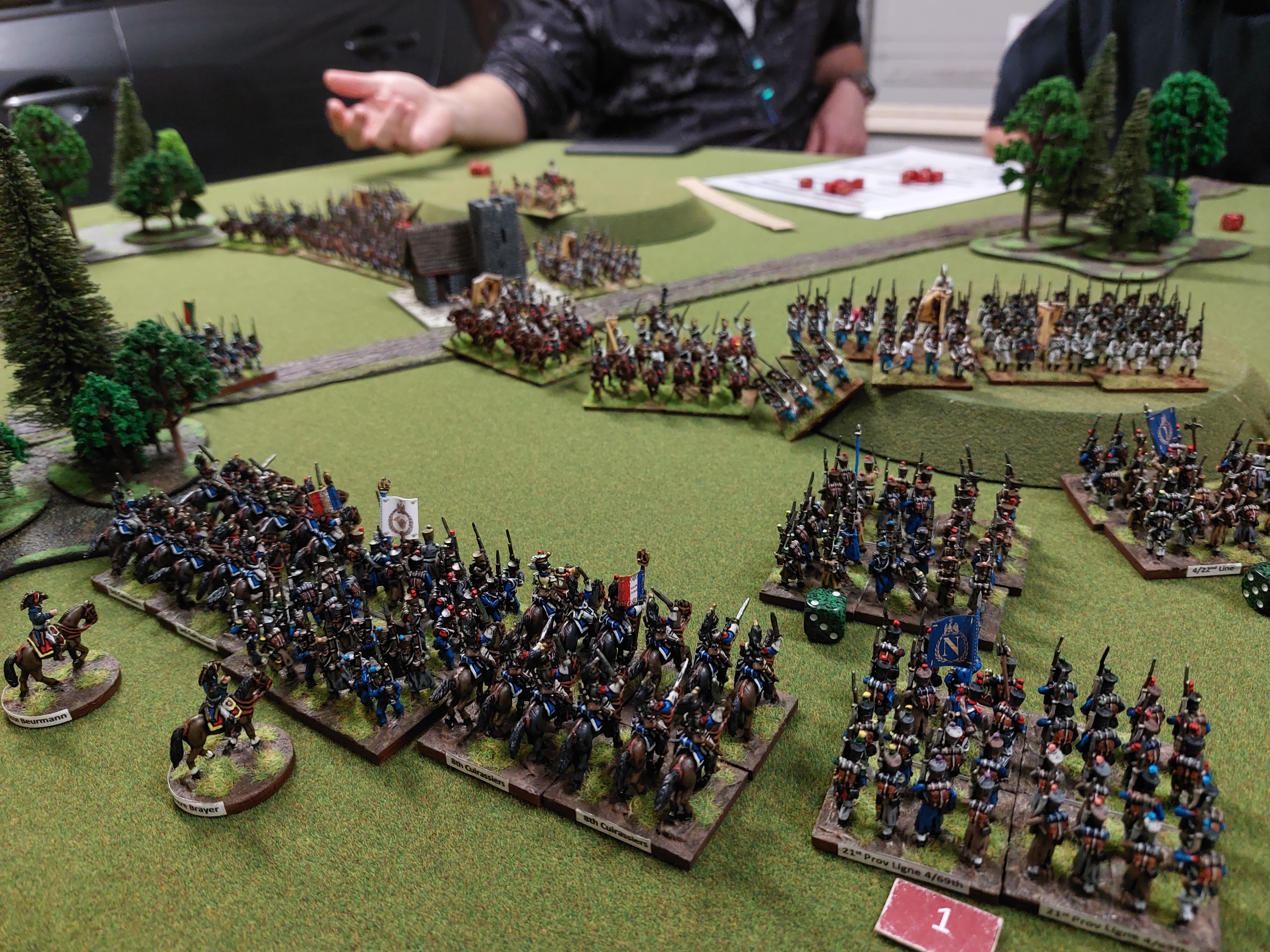
These images show the struggle for the centre and the flanking force in the background. It is taken from the moment of victory. The Prussians had angled their centre and were trying to fend off the French advance. The Prussian cavalry played a key role in this - especially with their 5+ disruption (?) roll - which helped shrug many incoming hits. 


As the Prussians had advanced of their right, it was their left which was held back. The French cavalry tried to take advantage of this with a hook into the Prussian flank and rear. A hasty repositioning of the Prussian cavalry stopped the French from causing certain mayhem by getting behind the Prussian flank. 


The above shows the French main attack. Marshal Mick had pushed an infantry brigade up in support of his cavalry. This put the Prussians in a nasty spot forcing them to endue several torrid rounds of fire. Some poor French musketry and average Prussian rallying enabled the men in dark blue to hold out. 


With MO needed to advance around the flank (including through difficult terrain) it was hard to have the points to advance the Prussian centre. These took sporadic hits from the French foot batteries who peppered their line. In addition, the French had placed their horse battery in a flanking position - pouring fire across the Prussian line (bouncing is a threat in Lasalle 2.) 


The Prussian flank attack shakes out and readies for a lethal bayonet charge. Mick played well delaying this by volleying and falling back. He rallied several hits from these units. The Prussian advantage was less hits and one more infantry unit. Marshal Mick also shifted a foot battery from the centre to bolster his line. But the Prussians pushed ahead. 


The French advance. 


As stated above, these images are in reverse order. The above shows the long road which the Prussian right hook took. It asked much of the centre to hold on. 


Here the Prussian cavalry only just got into position before the French could outflank the line. It took forgoing MO points and using the division commander to allow an additional formation change in the beginning of the phase. Unfortunately, I don't have an image of the original Prussian cavalry position. They had ridden straight into the centre of the battlefield and forced the French infantry into squares. This was vital as it held the French in place for the Prussian flank attack. 


Okay, going to brag ... those hussars look GREAT! These are my newest painted unit. They are the 10th Hussar who were attached to the III Corps of Ney, then Souham, during the 1813 campaign. The labels on my French units all come from this formation. Likewise, the Prussian labels are from Yorck's Corps from the army of Silesia. These forces tackled each other time after time in the spring of 1813 - my favourite period of Napoleonic history. 

Friday, 24 June 2022

Lasalle 15 mm Napoleonic Wargame


This week saw another Lasalle wargame. This time, after a close withdrawal but my regular opponent, I ran my friend Nick through the rules. He is a veteran of Blucher and this would be his second game of Lasalle 2. We used my Prussian and French armies and the same list (ie: 8 foot battalions, 2 foot batteries, 2 light cavalry and 1 horse battery.) Roughly 200 points. 


Nick tried repeatedly to work around the flanks while I tried to push forward and catch his troops before this could occur. It was an extremely close run event with a 1/3 sudden death victory condition and an 8 turn time limit. 


Before the Prussian could push forward on their right, the French lapped around, moving their battery into enfilade position. This did not have a telling effect but whittled a couple of hits from the extreme right unit. 


The rear brigade of French struggled to get into position and make an attack. The Prussians pulled back using the forest to impede movements against their flank. 


The centre saw French lines form to use firepower to break up Prussian attacks. This had reduced effect as the Prussian light cavalry made their advance in the centre. 


Uhlans charged past the village to rout the first line of the French central brigade. 


The Prussian left advanced to try and impede the French chasseur brigade who were trying to draw infantry away from the centre. This was effective but concurrently denied a cavalry presence to negate the Prussians. 


Prussian infantry advanced but were consistently unable to come to grips with the faster horse battery or cavalry. The ability of the French to strike the centre was reduced by this action. 


As usual with Lasalle, a major element was getting your units untangled to have enough room for the attack. Above, Blucher struggles for sufficient space to deploy his guns. 


To the decisive action, the Prussian cavalry charged again and again. Some rallying, most ineffectual, restored their ability to carry on the fight. Weakened French units succumbed over time. The pressure to have enough skirmish points to challenge the MO rolls and seize the initiative stopped the French player from putting infantry into square. This left several battalions vulnerable to cavalry attack. 


The Prussian left had pulled back, leaving the French left - dispersed into line - a difficult chance to try and envelop. Now attacking a single unit - protected by forest - the French did not manage to shake out from a conga line before their third unit was taken. 


Finally, after moving to right and left to obfuscate, formed for an attack. But, the Prussians utilised their commander's ability - forgoing additional MO - to snap into square. Without hits on the infantry, the French chasseurs would delay in charging. 


Meanwhile, Prussian cavalry sealed the victory ... but at 2 units lost to 3, it was a very close affair. Untangling units is still a major difficulty to maximise attacks. A forgot the creation of a grand battery in the centre which may have been useful. This game was decided by pushing to charge at the expense of volleys or cannonades. 


A very enjoyable game which uncovered an interesting conflict in tactics. This time direct assault triumphed ... but it could so easily have gone the other way. 


Wednesday, 18 May 2022

Lasalle 2 Napoleonic Wargame Battle Report


Another game of Lasalle 2, but this time we were blooding some new players and experimenting to see if we could play a 300 point game on a weeknight - with an early start at work the next day. 

Both turned out successful! 


Our game was ... run up and murder each other - rather than a scenario. My opponent and I both like the 1/3 sudden death victory condition - so we used that. After an initiative roll off, it was the Austrians to go first. With great haste they rushed across the field - using their maximum movement in march column. They pushed 3 of their 4 batteries to the front of their attacks and changed formation. A bombardment activation followed - hoping for many bounce through effects on the still marching French formations. A few hits resulted by nothing too serious. 

After this, it was the French who used their MO points. Faced with three batteries in key positions - two taking up a hill in the centre of the table (supported by a brigade of grenadiers) they decided to rush to the attack. They marched within 4 BW and formed attack columns. At this stage, the Austrians could interrupt and seize the initiative but as each unit had moved, changed formation and bombarded nothing could be done. Superior French skirmishing at the beginning of next turn would decide who would move first ... at it was the French. 

Attack columns smashed into the Austrian batteries before they had a chance to fire with two falling and only one being able to withdraw. The French had struck an early blow with 2 units of the 5 needed for victory falling at the beginning of Turn 2. Another Austrian infantry unit would follow as it had strayed too far forward allowing multiple attack columns to rout it. 


But now a harder prospect remained for the French. The grenadier brigade on the central hillock. They would charge against the mix of veteran and conscript French battalions - but to little avail. The French doggedly rolled 2-3 defence dice hits denying the Austrians the 'win by 3 or more' factors needed to easily rout opposition. 


On the French right, a single Young Guard brigade stood in the path of the Austrian Avante Garde. This mixed force only pressed ahead later in the battle. A furious French assault drew the attention of both Austrian players who continually invested command points (MO) into fending off and counter attacking the French centre and right. This suited Napoleon just fine as this is where the bulk of his forces lay. 


The Young Guard used 'le order mixte' and a battery to prepare a fearsome firing line. 


On the right a French brigade of veteran battalions continued to drive forward. They attacked a Austrian brigade depleted of one foot battalion and artillery support after the initial French assault. Columns surged back and forth but the French were holding on in defence and wearing down their enemies. Having a 3/2 advantage was weighing greatly on the men in white. It was here another battalion would fall - leaving the French one away from victory. 


The French now began to suffer some casualties - losing two battalions - but they still had only one to take. 


It was not the grenadiers who would fall ... 


The Young Guard remained firm ... though they would soon be forced into squares by the approach on one regiment of cavalry. 


It was the French cuirassier who swept from their reserve position into the centre. Quickly striking at one Austrian cuirassier regiment with a two to one advantage (16 dice to just 5) it looked like the game was sewn up. But their steeds stumbled and they struggled back. 


The Austrians countered but stumbled themselves while the French reformed their squadrons and achieved the 3 or more combat factor - routing their opponents. 


It wasn't the glorious first charge of heavy cavalry that decided the battle but it was achieved in the swirling melee of countercharge that proved crucial. At this the Austrian commander withdrew his troops losing 5 units to 2. 

Lasalle 2 continues to impress. We have a bit of trouble in organising our forces (our troops keep running into each other during formation changes from march column to attack or mass formation) and I intend to make a transparent template to aid alignment and direction in charges. I really want to introduce the advanced skirmish rules and the command trait - as atm it is too tempting to commit your general to generate an additional 1d3 command points at the beginning of each turn. Having a alluring alternative gives another head scratching command choice that I like in my wargames.