Wednesday, 12 September 2018

Rabbit Stew

The next of my infrequent reports will be a return to Lion Rampant.

I like to pit the Baltic Pagans against the Northern Crusaders. This is a wonderful period to learn about and play within. Lots of colour and interesting background. The small groups of knights that tried to carve an empire from the thickly wooded lands of the north is very evocative. Just as inspiring is the struggle of the pagans to expel the followers of the grasping god from their homeland. 

This week we did scenario ... ahhh ... ummm ... D or E i think. The one where one side has to march across the table while the other attacks. 


The worshipers of the mighty forest rabbit had over extended themselves whilst raiding and the Brotherhood of the Sword had swooped on their opponents as they returned home. 


The crusaders had to split their forces between the NW and SW corner. With their mounted units they would attempt to catch the pagans in a pincer. All the while their crossbowmen would harry their opponents from the rear. The spearmen pictured above would be tasked with holding their advance for as long as their schiltron formation could manage. 


Here the pagans surged forward. Large units of fierce foot, one bidower and a single unit of heavy foot men-at-arms. The bidowers were thrown forward and to the left of the foot troops in the hope they could shield other units from the crossbowmen's fire. These bidower troops rained turn after turn of arrows down on a variety of crusader troops but were little able to damage more than their skirmisher equals on the other side. 


The much prized crossbowmen whose job it was to scythe down their foes. The pagans lacked the missile troops to respond and their haste to reach the other side motivated them to try and ignore this threat as best they could. These troops would initially prove slow to activate and enter the fray. 


The table - complete with large rectangular snow drifts? (just army lists that I should have removed before the image was snapped.) The road marks the intended passage of the Baltic pagans. The topmost image of the two shows one crusader force which intended to harry the pagans from the rear. It also shows the pagan's plan to throw the bidowers toward the crossbowmen in the hopes their skirmishing would absorb some bolts. 


The spearmen were pushed forward by their unsympathetic lord.  


The mounted sergeants moved into position. These troops were much maligned on the evening but would prove instrumental to victory. Early activation failure caused them consternation. 


The early turns favoured the pagans. Time and again they managed to motivate their entire army. Fierce foot units streamed toward the centre of the table. The crusaders cursed as the pagans mocked their pale and deceased god who lacked the virility and speed of the forest bunny god. 


Still they surge onward! We shall smash through this Christian rabble to reach home!


The leader - Lord Leopold Swain - famed hater of the forest peoples, pagans, slow witted, withered or lame - sat back in apparent inactivity. This caused the crusaders to fall into internal bickering throughout the evening but may perchance have been a master stroke as they were preserved for devastating actions later. 

It wasn't a bad move as with the wild charge rule such knights can be drawn to their doom in rough terrain by such units as fierce foot. But this was to cause the internal squabbles. 


The pagan march forward continues. The lone spear unit begins to question their resolve. If only our shields will hold ... 


The cavalry are in position but - due to the bickering which rose in intensity and insensibility at this point - no charge occurred. I'm sure this will also be claimed as a master stroke of tactics in the annals of the northern crusades - but at the time the pagans mocked their craven hearts. 


Form up lads, this will sting. 


Several wild charges by the pagans followed into the spear whose schiltron greatly prolonged their lives and ability to absorb damage. Only when they fell to half strength did they shields and resolve falter. 


Only one of the pagan units remained at full strength. Crossbow bolts from behind and the spearmen had taken their toll. Spearmen are fantastic defensive troops who fight better when receiving a charge. The schiltron formation raised their armour to a near impenetrable 4. 


The knights finally came forward just as the spearmen faltered but the first action was by the pagans who issued a challenge. "May the Giant Rabbit kick your nethers," cried Catweasel Hairyknuckles - the leader of the Baltic troops. 


This first challenge was but a draw ... the first indication that the Christ god was stronger in the north than the pagans had hoped. 


This above image shows the perilous situation for the pagans. Now surrounded but only able to forge boldly toward their objective, they were trapped by situation and tactics. Bolts plunged into their buttocks while horse threatened. One unit of fierce foot had been destroyed by fire while 2 others were sapped of their strength by bolts and pointy spears. 


And now the cruel Lord Leopold drove home his advantage and repeatedly charged home. The earth and camera shook as the heavy hooves impacted the earth. The elite pagan troops gradually fell. Now the activations deserted the pagans and the christians held the initiative. 


In desperation - or courageously - another challenge was issued. 


And with three swift but decisive blows Catweasel's skull was cloven in and he twitched upon the ground to the delight of Leopold - oppressor of the weak. 


Now stark horror stalked amongst the ranks of the pagans who knew their might rabbit god had simply sodded off or burrowed deep underground. The other Crusader cavalry unit - after recovering from very hurt feelings - returned to charge into the exposed rear of the weakened fierce foot. 


Between the hammer and the anvil. 

Probably enough said. 


The shaky cam is not only bad photography but also an accurate depiction of the fear in pagan hearts as they ran into the wood. This very unit let fear be their master as they successively failed to activate and annihilate the last of the men-at-arms - avenging their leader. Fierce foot are very poor defenders but able attackers and these were still just above half strength - thus still rolling the maximum number of attack dice. With lower defence values and being at half strength, the men-at-arms may have fallen. 

This marked the final failure of the pagans who had advanced so boldly into the centre of the table ... to be here cut down and have their bodies trampled into the mud by the unyielding hooves of the invader. 

Fortunately, the forest is filled with eager hairy men leering from behind each mighty oak - keen to display the virile virtues of their Forest Rabbit deity and replace the losses suffered on this bleak day in the far north. Both their tunics - and the North - will rise again! 

Thursday, 23 August 2018

Order and Chaos

This week's offering to the gaming gods consisted of a side of Star Wars with a libation of Sharpe's Practice ACW.

Both games were enjoyable and fun was had by all ... but what happened?

Ian (Confederate) and I (Union) renewed our feud once more. On the other table Nic had supplied everything - including a lovely space gaming mat - and was Admiral Akbar to Jason and Micko's Grand Moff-Tarken (I have no real idea how to spell that.)


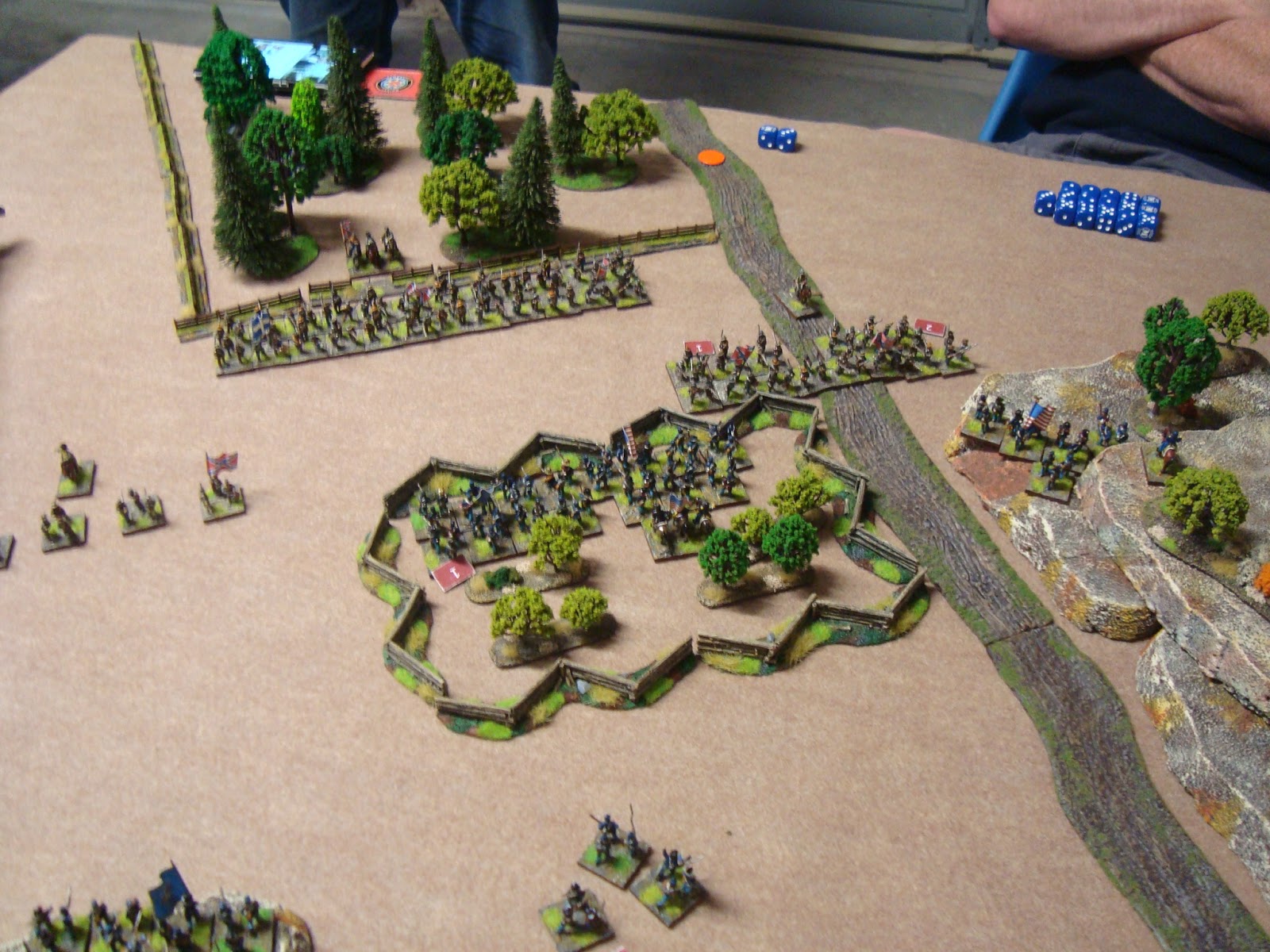
Sharpe's work very well for ACW. As in previous posts we use a stand of figures to represent a figure. We consider each unit a regiment and the rules respond kindly. I always supply the Union with an additional command but the Reb's have superior troop quality and therefore higher morale. Given the card based activations, it is very hard to bring a numerical superiority to bear as usually parts of each force seem to receive cards irregularly at best.


The cards do represent the ebb and flow of battle initiative quite well as each side seems to enjoy periods of every game where a run of activations allow a side temporary dominance only to fall into lethargy later. Perhaps their energy is temporarily spent (I do note though that gamers imaginatively like to create explanations to justify any rule aberration or nuance to keep their favoured rule system being played ... Am I doing this here? I'm not sure I'd know even if I was.)

Back to the game ... The Union were aggressive this evening and pushed forward with all commands quickly. The dice decided to limit this advance and replicate some prevarication of less than competent commanders in the Union ranks - trans. I rolled low for movement throughout the night.

The Southerners pushed forward with their skirmishing troops infesting Old Scroggin's Orchard and Turkey's Knob - a central high point on the battlefield.


Before too long, the main brigades of both sides deployed and struggled free of woods and fence lines to take better positions. The Union established a strong line along the snake rail fence which was built beside the main Lushville Lane. 


However, the Union commander - confident in his numerical and moral superiority - ordered his men forward to gasps of amazement from the Rebel General Blackcat. The Union skirmishers threw caution to the wind and charged the Reb's in Old Scroggin's orchard driving them from their position and taking it for themselves. From here successive card activitations fell for the Rebs who poured fire on the Union skirmishers and they played no other role that evening. 


By this time the Union battle main battle line had advanced and was eager to take the orchard and make it into a fortress. If only their flanking forces could advance their position would be safe and the rebels would have to chance risky tactics to dislodge them. 


The Union right failed completely to support the centre. One Union regiment was ordered to charge and drive the Reb skirmishers from the brush on Turkey Knob. Poor movement saw them repeatedly raked by volleys which led to an accumulation of shock. This resulted in removal of combat dice and the Union were sent packing. 


Meanwhile ... space things happened. 


I have no real idea what happened. 

But doesn't it look nice. 


Then the cards displayed a fatal shift of initiative against the Union. 


Once in position they lost their nerve - perhaps disordered by terrain or were the Confederate troops energized by this threat? Volley after of volley crashed out from the Rebel line disordering, injuring and killing the brave northern men. 


Shock and casualties grew but - as often happens in the Sharpe's Practice games - it did not effect the moral of the Union in any way. Sure their combat effectiveness was severely curtailed but it did not bring the South any closer to victory. 

(An afterthought here is what would have happened if the Confederate's had risked a charge? Probably victory - with some "acceptable" losses but they are lead after all - and this would have resulted in multiple morale loss rolls for the Union. This may be how it is supposed to be played?)

For the Reb's their moral had been slowly falling throughout the evening as they lost several combats, leaders and a unit here and there. BUT ... again a quirk of Sharpe's is that if you roll low for morale loss your force will succumb VERY slowly indeed. 

It always reminds me of "The Death of the Thousand Cuts" when I play Sharpe's. The morale system needs a tweak. 


So at the end the Union morale was still high but the South was down to just 4 of a once proud 11. Yes, the Union were just about to lose quite a few - if they didn't retire - but probably not quite that many. One attempt at retreat by the North led to a total of zero movement as low dice, terrain and shock combined against this order. There would definitely be more blood before the soldiers would reach safety. Who knows ... high rolls here could see the Union morale tumble - but they still had 10 of their initial 11. 

Due to the advance of the north, the rebs had the whole table to march before reaching their objective - Syd James' Crossing - and the North still had three strong units and a working battery to pepper the rebs as they came. 

Both sides agreed on an amicable draw as it was late and neither side could move from its strong point without ensured destruction. As the sun went down the cries of the wounded could be heard echoing from Old Scroggin's Orchard but each force knew it had done its derndest and were not ashamed for their efforts, bravery or the cause for which they fought. 

The commanders knew that wargames was the winner once more. 


Wednesday, 8 August 2018

Flashing Scimitars


This week's game saw the second return of an old friend - DBR. Many years ago - perhaps 15 or more - I really liked it. I have always enjoyed DBR on a smaller scale - around 20-30 bases - but I have no strict limit. For several weeks/months I have been dropping the name 'DBR' as regularly as I can without pushing the issue. One player, Ian - my opponent for this game also - has been driving very hard for months to play more renaissance gaming. This has found support but few of us have such armies and no-one can really agree on rules - but that has become endemic over the last twelve months in our group - and I cannot claim to have not taken an active part in this process.


I had proposed a solution ... an eastern renaissance match up ... but in DBR.
It didn't happen straight away ... but we are a club of varied tastes which plays many games.


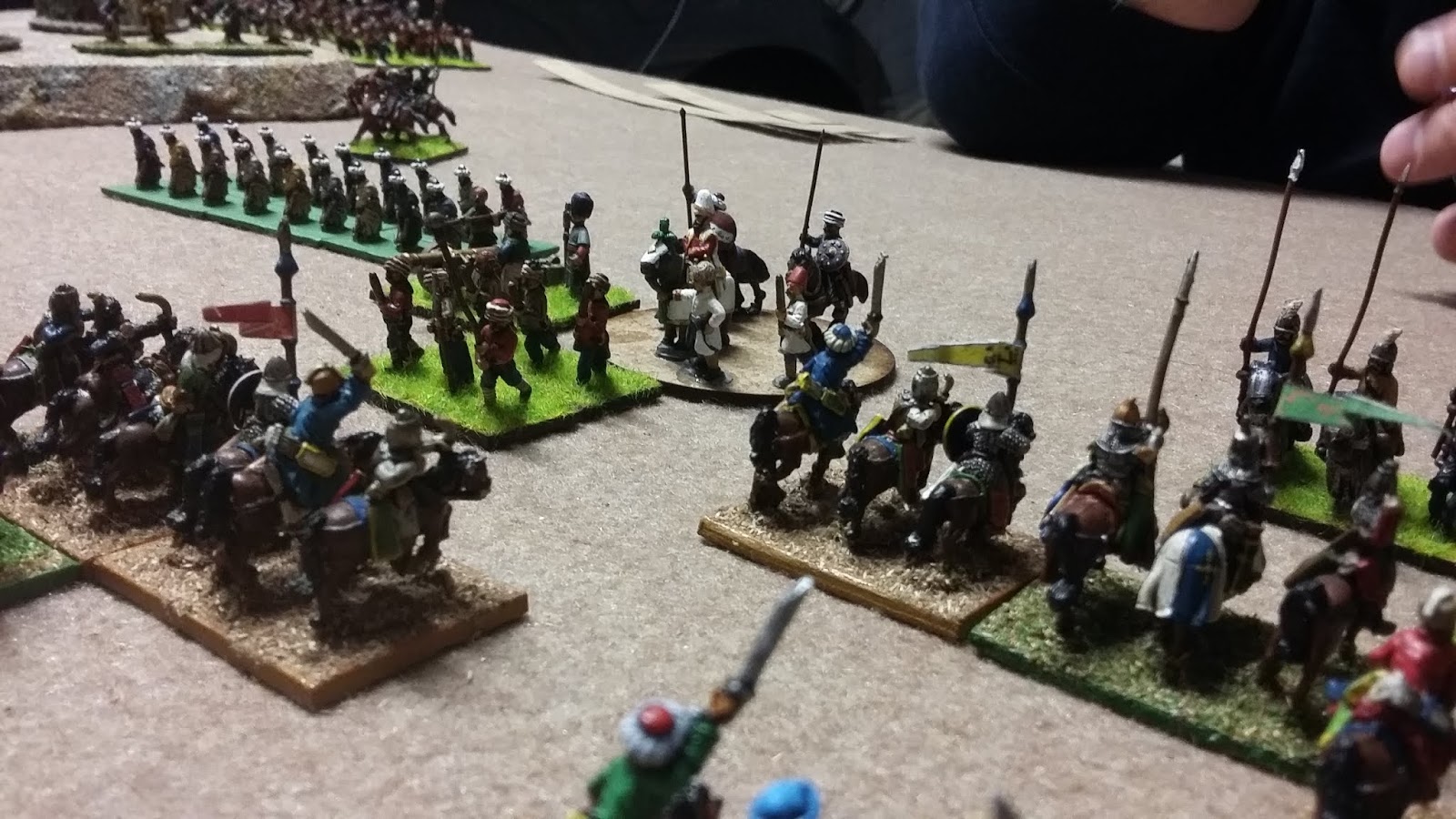
In any case, the second DBR game occurred with my medieval Turkish army pressed into service as Safavid Persians while Ian ran his Later Ottomans as ... Ottomans. We played with 300 points and 2 generals each. I like to play a relaxed version of the rules. Time period was around 1550.

Ian played a defensive game with his main battle line of cavalry, janissaries and azabs while he pushed forward akinjis on each flank. My Persian Shah decided to advance slowly in the centre while using a stronger force on each flank of Turkomans, light infantry and feudal cavalry.

The Turkish Pasha hoped the massive bombard - that 100 oxen had dragged to the field - would disrupt the advance and battle groups of the Persians. It didn't.


Above is one of my flanking forces swinging about the hill after they had dispatched the akinjis - one of whom had fled off and lurked in the background.


The main Ottoman battle line were held steady by the Pasha's orders.


Prayers and cries echoed across the plain but there was little movement in the centre.


On my other flank I had also driven away the akinji force and now eagerly trotted to meet the azabs. My men knew Allah was with them and were sure of victory. They were deluded.


With the flanks secure it was time to advance in the middle. The Shah felt sure he could crush the Turks with an attack on three sides. He would see the vile Pasha flayed alive before the sun set.


And battle was joined ... arrows flew, horses whinnied, scimitars flashed and men screamed blood curdling cries. The lines of sipahis surged back and forward with only a base or two lost. The generals of both sides were influential in keeping the lines in place. The superior class of many combatants also aided this.


Meanwhile, Ian had been forced to order some of his centre cavalry onto his left flank to meet my advancing thrust. For several turns the struggle surged back and forth before additional light troops turned the table by providing an overlap.


The guard cavalry from both sides clash again and again.


Iranian cavalry have cut through the janissaries but behind the azabs have annihilated the advancing left wing. Their bows did what arquebuses could not and scythed through the galloping horses at longer range. If the azabs could swing onto the Iranian flank the battle would be lost.


Not quite a final image but an overview. The Ottomans broke first but the Iranians were only two bases away. The azabs were certainly the surprise packet of the evening - Bw (I). The Persian right hook pressed into the Turks and took the last couple of bases but not before the Shah fell in the thick of the fighting. But this was masked but the whirl of dust and noise of battle and it was not until later that the Persian force withdrew mourning its brave leader. The Turks had lost many men - especially their janissaries - but these would be replaced and this defeat would be avenged.

Both players enjoyed the game and I'm sure the Ottoman invasion will not be delayed for many weeks. My memories of DBR were justified and I have found the recent games just as enjoyable.