Thursday, 11 February 2016

Zeus smiles once more ...


I have been remiss by missing three battles from this journey including Alexander's first defeat at the hands of Proconsul Brooks and a draw against Hannibal of Carthage - who Ptolemy slew in combat. He was back for revenge tonight as he returned to form through the will of Zeus. 


Rob was sporting his new camp, purchasd at Cancon, which we both think is rather splendid. He deployed this forward as it was fortified, the rest of his army trailing back from on each side. Rob loves to infest hills but tonight this let him down as his cohorts were too far back to easily effect the fray (in his victory against me one cohort held the flank while on a hill against two companion units.) 


The Macedonian centre surged toward the camp guarded by only two cohorts as two others marched across rough hills to save them. 


In the centre Thracians attacked Roman slingers, Alexander decided to try to rally a hit from them ... it didn't work. If the slingers fell the thracians could attack the rear of the cohorts striving to drive off Ptolemy's right flank assault. 


At one cavalry unit routed each the flank was hanging in the balance. After Ptolemy's impact charge the roman cav had but one hit left before breaking. The infantry would slog it out for much longer. 


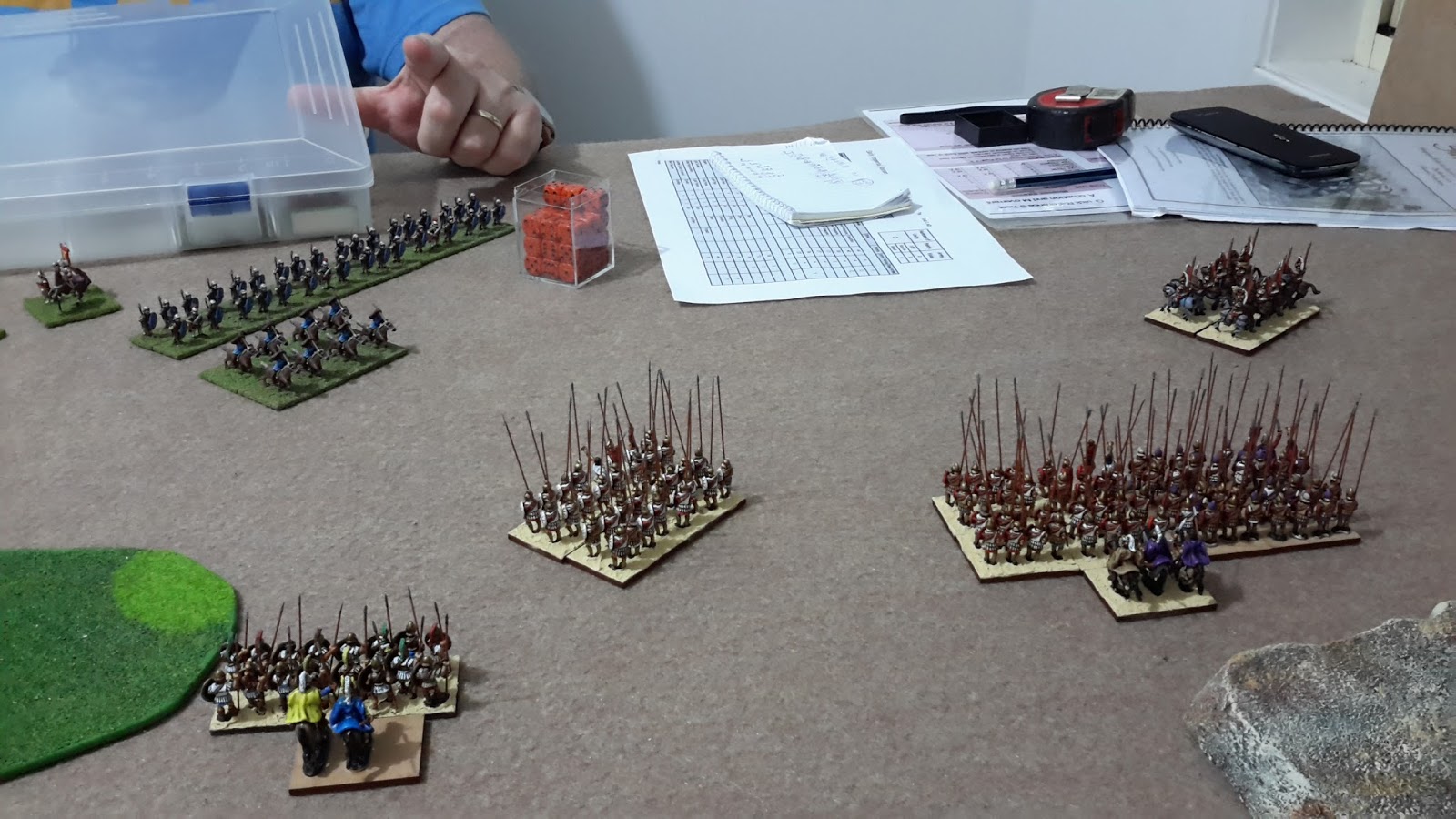
After Ptolemy had crushed the last of the opposing cav a cohort charges to the resue of the roman right flank. They manage to catch the companions before they could charge and a prolonged meelee ensued in which the low discipline of the cavalry kept them fighting and fresh. Victorious thracians loom in the background ... this looks grim for Rome. 


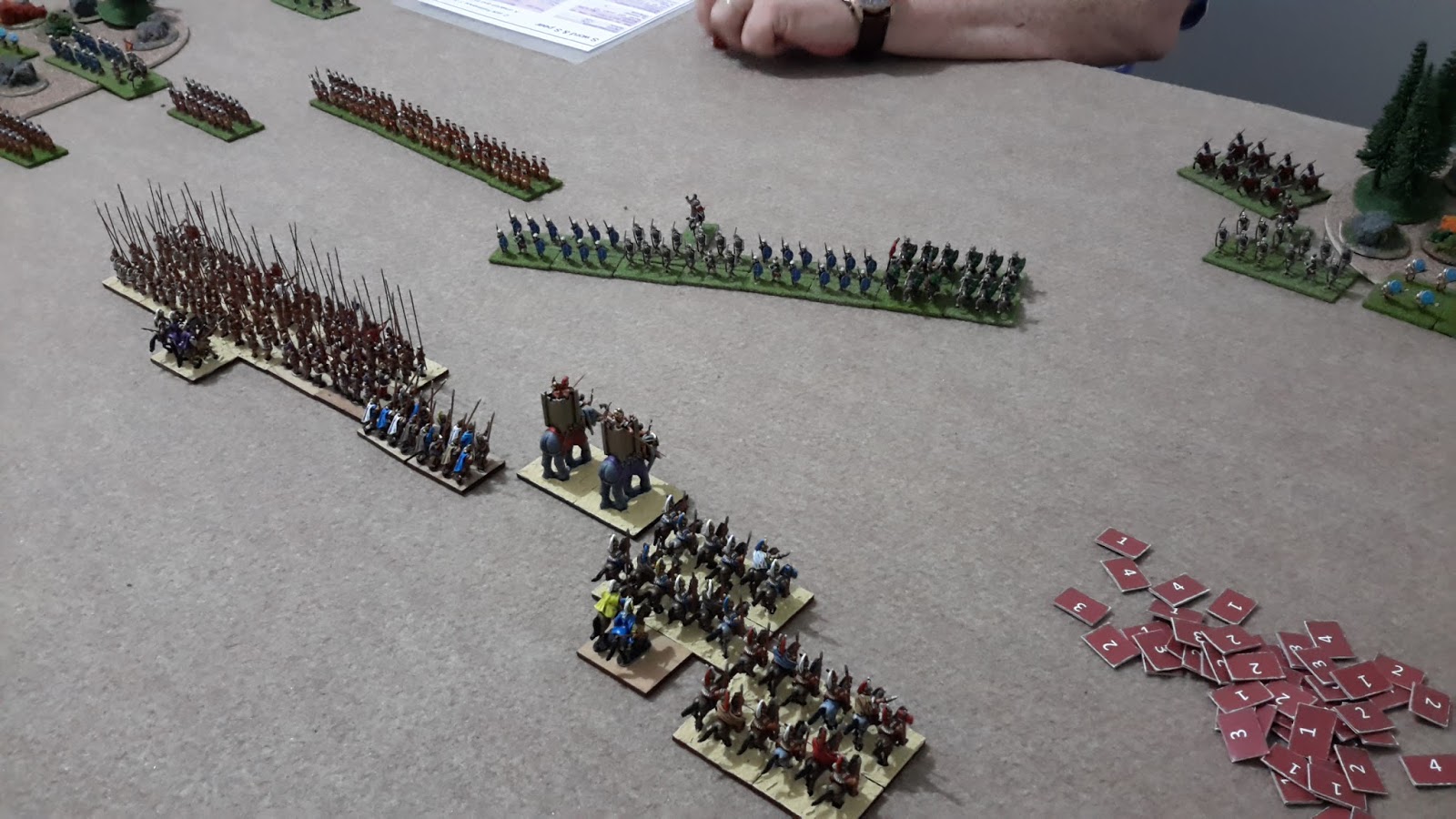
Looking back toward the camp. Pike crashes into cohort inflicting heavy damage, the camp is threatened and, after their epic march, the cohorts descend from the hill to be threatened by hoplites, peltasts and corinthian allied cavalry under the command of Craterus. Hits were mounting and routs were imminent!


The thracians decided the flank battle crashing through one cohort with romphia and ready to take another. Romans teeter on ful scale rout, the Macedonians have lost slingers and one companion unit. 


Two cohorts crumble before repeated assaults from fresh pike. The battle ends with Alexander's royal purple pikemen smashing on the camp door. 
Zeus, Apollo and Ares be praised ... victory smiles again on Alexander! 

Friday, 29 January 2016

Alexander marches west

The 4th game for my new army, and the first in which my basing was finished, was again against Proconsul Brooks and his imperial Romans. I must say  i am thrilled by the appearance of my Macedonians. Sure, this isn't professional painting, but it is an achievement for me.
 Back to the game ....

The Romans deployed first after deciding to commit less scouting dice to the contest. Rome had a clear advantage in medium troops, through their armoured auxilia, but did not make use of the rough terrain. Alexander decided to deploy forward, winning the race to the rough terrain on the flank. He would plough his phalanx straight into the medium Roman foot ... in the open terrain. Alexander's cavalry would hold back .... which was exactly what the legion was doing .... which did not end too well. 


The Macedonians stack their right flank, ready to overwhelm then turn onto the centre. 


The Romans deployed their auxilia forward ... would they be able to be supported? 


The proconsul pushed his cavalry forward on his left ... but this took time to perform and make a line ready for battle. 


Meanwhile, the Macedonian attack was in full swing. Archers are competent troops against lights, mediums or cavalry but struggle to make a dent in a line of heavy foot with shieldwall. The Romans threw forward a semi-sacrifical medium foot unit to slow the advance. Would Ares smile upon this offering? 


The lone unit battled bravely, but its only support came in the form of flights of arrows. These did not deter the advance.


On the right, Alexander awaited the Roman advance, happy for them to be using dice to move forward quickly that he was using for the left flank combat. Polydamas and Onomastus, my elephants, calmly awaited the cavalry dreaming of carnage. 


The Scythians shot away the Roman light cavalry ... the flank was open! 


The first pike unit was released ... it annihilated the first archer unit but was halted by the second it pursued into. 


The Roman cavalry flinched, charging the elephants. The result was predictable but this sent Polydamas and Onomastus careening forward without support. It also bought them in range of the Roman scorpio's. 


The Roman flank was battered but not yet broken. However each auxilia unit faced twice their number of opponents. 


The elephants, although peppered with shot, stomped their way over a cohort of raw legion before halting on another legionary unit. The Roman legate, frustrated by their success, turned a unit of cavalry to flank them. Hoplites and Greek allied cavalry from Corinth rushed to support but it was too late for the jumbo's ... but damage had been done. 


Better coordination by Alexander and Craterus on the left saw heavy foot unit after unit crash into the Romans. It was now revealed how damaging the rear deployment of the cohorts had been. They now advanced slowly and piecemeal to the fray. 


The Greek cavalry held up the armoured Roman lancers (impact cavalry) while the companions trounced the other unit. 

Here everything went astray for the Macedonians ... two units were lost. One companion unit fell to a volley of scorpio bolts. A hoplite unit then took four hits in one round of combat (!) and a single cohort pushed through onto the flank of a pike block. Having six hits however allows a pike block to stand up to surprising levels of punishment. 


The end of the battle ... Roman units held up for a while but eventually fell to the pike push and the peltasts flanking move. Besides a slight hiccup the forces of Alexander taste victory again. The Romans broke while Alexander had lost but 3 units - 12 army points - still a way to go before 1/3 losses. The Macedonian army certainly feels stronger in 500 pts than 400 but a stronger challenge awaits at he club this Sunday ... battle against a first Crusade force .... a large offering to Tyche and and Zeus will be required. 


Thursday, 21 January 2016

Alexander versus Aggrippa Round 2

Tonight the old grudge was renewed as Proconsul Brooks again had the gall to face my Macedonians. This time we played a 500 pts game of Sword and Spear as I had daubed some new units (all Forged in Battle excellent 15mm range.) Swelling the ranks were a unit of thureophoroi, scythian light horse and my elephants ... i had already named them ... Polydamos and Onomastus after two famous ancient greek wrestlers/boxers ... and didn't they live up to the reputations of their glorious antecedents tonight!
 Outscouted the Macedonians deployed to one side as they only had the light troops to contest one difficult terrain area. Their companions were on the right facing the angled flank of Roman auxilia medium foot and bowmen.

Below the fight for the rough going commences ... each general would commit more troops to this struggle. Battle here dominated the early phases of the game. Alexander hoped his javelinmen could engage and drive off the roman slingers. Initially Aggrippa held back his medium foot but it was soon injected here to avoid losing this area thus enabling troops to attack the flank of his main battle line. 


More troops join the fight on this flank ... a legionary cohort advances, auxilia led by Aggrippa himself and cavalry begin to ride around the side. Hoplites hurry to gang up on the cohort while the scythians try to shoot the remaining slingers away. 


Above shows the other side ... the angled and refused Roman flank decides to come forward to the joy of Aldxander. He throws all forces forward to smash these units before the legion can support. 


With great trumpeting blasts Polydamos and Onomastus near their foe. Hails of arrows from auxilia bow were turned aside harmlessly by elephants and companion cavalry alike. This was going to hurt! 


Back to the rough stuff, peltasts fought auxilia and hoplites fought legionaries. No-one, at this point had an advantage. Aggrippa urged his men to fight but his voice was seemingly lost among the rocks and bushes of the rough ground. 


The purple pike ... unnamed as yet ... are first to charge ... these trample a medium foot unit who dares oppose them. 


Looking across the battle line ... the legion seems content to let the auxilia fight it out. This decision would cost the romans. 


With a deafening roar the romans charged the elephants who routed them almost effortlessly. The mighty giants then pursued into the lone roman cavalry unit on this flank pinning it in combat. It haplessly awaited the companions to charge with full impact. The thuerophoroi, providing the link between phalanx and flanking units, charged the now isolated auxilia bow. Not a pleasant match up for the romans. 


Above shows the moment before the two units of Macedonian companion cavalry are released. At the top left shows the phalanx about to engage the legionary centre ... pike vs pila ... what would the result be? 


The consequence of impact charges ... the red companions ran down bowmen then pursued directly into slingers who were also routed. The blue and yellow companions, under the command of the dependable and lion-hearted Ptolemy, inflicted only one hit on the roman cavalry. However the subsequent combat with Polydamos and Onomastus proved fatal ... the elephants pursued narrowly missing stomping on some light cavalry too. The roman flank was not just in tatters ... it was gone ... including the commanding legate ... whose fragmentary corpse now decorated the toes of Onomastus! 


The initial fight still dragging on ... the hoplites had taken casualties but still remained in the melee. Aggrippa's presence still failed to motivate the auxilia ... the peltasts had suffered two hits but were desperate to win. Light foot with bow had flanked one cohort. Would this be enough to turn the fight? The romans had by now lost one third and the resulting tests saw panic begin to grip Rome's warriors. 


The end of the battle ... the cohorts had been humbled and auxilia decimated. Alexander had lost but one unit of javelinmen (although his peltasts and one hoplite unit had almoost broken.) Aggrippa fled from the combat in the rough going with only the roman cavalry fighting on. The remaining cohorts woud soon be surrounded and at the point their resolve faltered and a full scale rout ensued. Rome had suffered a terrible loss this day. But, as Polybius noted, even in the 2nd century BC, Rome's reserves of manpower make her a fearsome and indomitable opponent. I'm convinced Aggrippa (alias Proconsul Brooks) would be sure to return. And hopefully by then I can finish the bases on my army ... to be continued ...


Thursday, 14 January 2016

Alexander vs Agrippa 15mm Ancients wargame

The third battle for my Macedonian army erupted this evening as the early imperial army of Proconsul Rob blocked my advance into Italy. The Roman army used an altered list placing greater reliance on light horse, archers and auxilia heavy foot. Alexander trusted to his tried and true formula that had so far netted him 3 victories ... 3 pike blocks, 2 hoplites, 2 companions, 1 allied greek cavalry, 1 light cavalry and 1 slinger light foot.
 Deployment saw difficult terrain stacked on the Macedonian left so they refused that flank and had the phalanx and companions leading on the right. The Romans stacked their opposite flank but their main attack was led by their archers and cavalry units.


It was uncertain whether the phalanx would be able to travarse the enormous gap between the main enemy battle lines. The Romans too were never able to engage which may well have put too much pressure on Alexander's command dice pool. The Romans decided to rush onto the Macedonian left flank trying to overwhelm it. Key to this would be peppering the enemy line with archers who would infest the central wood. This tactic would prove less than successful as the Macedonians withdrew their lights out of range leaving the archers to fire at hoplites to little effect. 


The slingers, straying too far forward, ran back in the nick of time. 


Riding hard from the far right Ptolemy arrived just before the Roman cavalry attacked. His billowing blue cloak was seen by the men and inspired them to hold firm. He has consistently fought like a lion in all three battles. Craterus, usually commanding the left flank, can be seen in a brilliant red cloak. 


The greek light  cavalry tried to flank the Romans. This tactic failed as they were swept away by the opposing light cavalry who then turned the Macedonian flank. This unit had a chance to do this but the noble general Craterus, who had not performed well in the last battle loosing his flank, made the single critical discipline check to prevent his allied Greek cavalry unit from routing. 


The action on this flank was fierce. With the romans defeating the greek light cavalry then their archers destroying a unit if hoplites the confidence of Alexander was beginning to wane. Craterus however was taking matters into his own hands crushing the Romans facing him and running down the general. The subsequent morale test robbed the remaining Roman cavalry of their fresh status. 


The key moment above when Craterus saves the day. In the top of the image a second hoplite unit was injected into the fray smashing the medium foot archers to revenge their compatriots deaths. 


The heavy lines close the gap. The companion unit on the right of the image would prove key to the conclusion of the battle. 


The flank clear of Romans. The slingers introduction to the flank of the final cavalry unit ensured their demise. The allied cavalry under Craterus turned to face the flanking light Roman cavalry annihilating them. 


The flank free of Romans. At the top the victorious Ptolemy had joined the remaining hoplites leading them to the fray. By now the Romans had reached their demoralisation point with several units gaining hits from the subsequent tests. 


Although the Roman bolt throwers sent several missiles plunging through one phalanx block the Macedonians were able to muster equal heavy foot units to the Romans (who had now lost five units - and thus dice - while the Macedonians had lost but two.) This is when that, so far unengaged, Companion cavalry unit on the right came into play. With each Roman unit matched to a Macedonian block, none could prevent that Companion unit from attacking the flank. The game was called with very minimal losses for Alexander .... his brave march could continue. Hopefully he would soon be able to call on additional units and expand his battle to 500 pts.