Sunday, 22 April 2018

Jungle Table

So ... how much jungle have you actually got?

This is a question I asked myself about an hour ago.

This much. Table is 6 x 4.


There are 9 medium sized jungle areas on the table. Approx 10" long and 6" wide. 


It looks thicker in person. 


Flash Your Dark Ages!

Well, I have got them and these aren't very good images of ... them .... erm ... 

I was going to do a Lion Rampant battle report but then ... I didn't.


This unit I would use as Viking Huscarls. I want to increase the unit size to 8 in my Lion Rampant variant games just for appearance. I don't intend - atm - to change the unit size in the game - will still function at 6. 


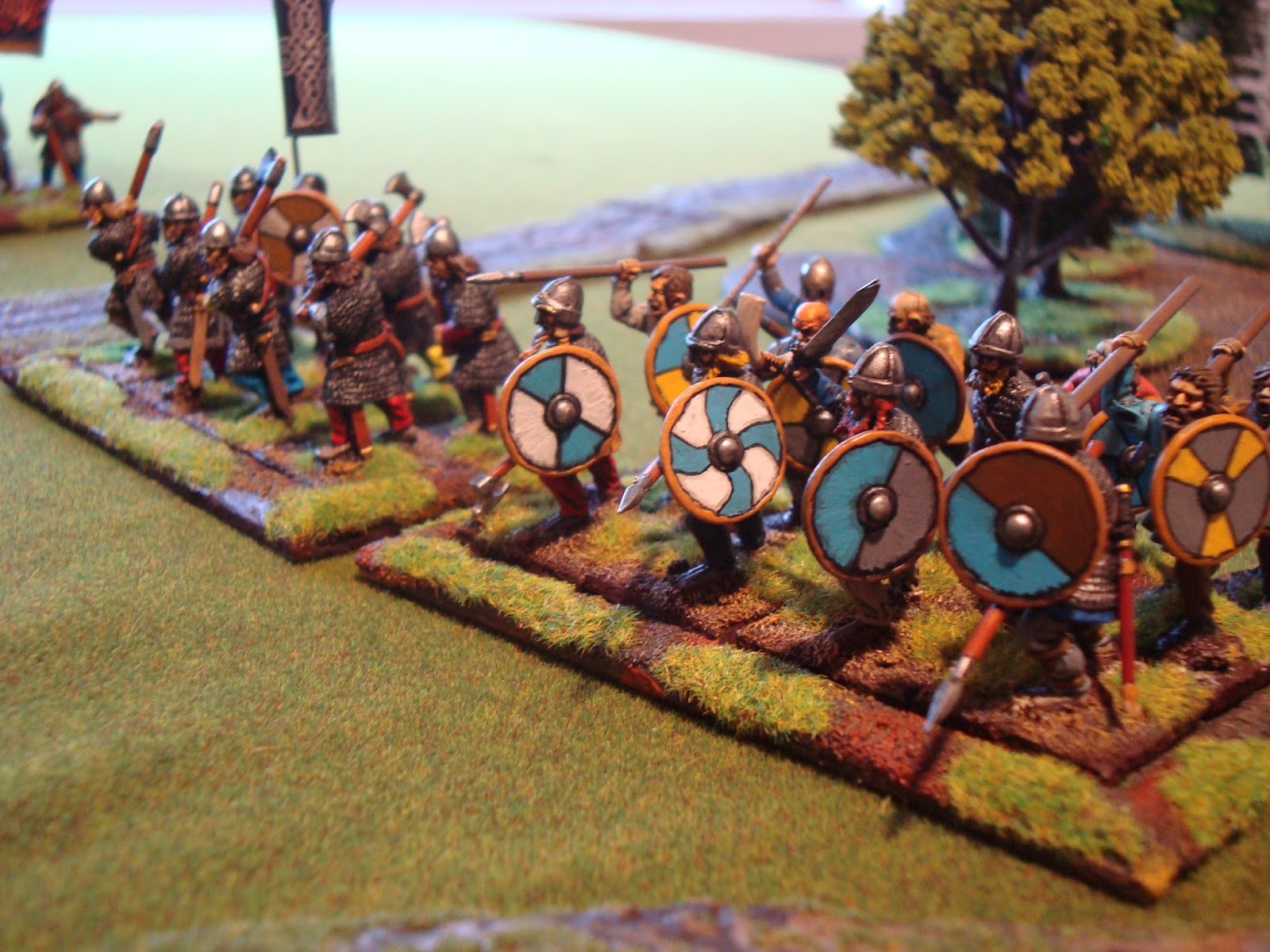
Bondi fresh off the longships. I like to have a front rank of mailed warriors backed up by warriors in tunics and often without helms. 


How did these guys get into another snap? A better image of the Viking general I like to call "Eric Bloodaxe" (or Anlaf) in the background. 


More Viking bondi. I like grouping similar shielded models into a single unit. To my mind this could have been a way that such warriors in this period distinguished themselves and built morale and displayed communal spirit. 


More huscarls behind - these with dane axe. 


The good guys - err - Saxons. A units of thegns. Ready to die for their lord - shown behind on the barrow - and make good their oaths sworn in the mead hall. The lamb and cross will protect them. 


More thegns. Monks in the rear. They've got a piece of the true cross you know. Been handed down since Mount Badon when Arthur very carelessly kept charging people with it. 


Now to the fyrd. Same idea as the Vikings - mail to the front with similar shield patterns to mark specific groups. 


Nope, not the same unit. I do like red/white for the Saxons. 


From behind the Viking line. Across the ford ... to plunder ... I mean glory!


A slave - skulking from a flogging - peers through the trees at the war hedge. Will the Saxons triumph? 

Wargames Terrain - Marsh

This is my third attempt to make marshland for my wargames table. 


My mistakes have been many. The thought expended on this project - procrastination mainly - would total months of time. 

I'm very happy with the paint job here - especially for the watery areas. I'm now really nervous that I'll stuff up the watery resin part and ... I think there may be swearing at that point. 


I really wanted to use mounting card and not MDF as I don't like how raised it appears from the wargames table. I mean you always look down at a swamp or pond don't you?


Here was my practice run. So close! I added a little too much paint to the water mixture - I'm using a two part resin and hardener combo - the same I use for my very successful sea tables. 


Here was another problem - putting some grass on first. It just sucked up a lot of the water mixture. I don't like this effect too much. 


Nice and thin. The way I want it to be. Just a mounting card base, a outer rim of thinner cardboard and a stipple of polyfilla then dry brush. 

Friday, 20 April 2018

Congo Scenario 2 and my new Trees

This week I played scenario 2 of Congo once more. I had a few additional bits and pieces to utilise, mainly my new trees but also some skull on a stick markers. 


Above Kong prowls about his lair. In the background the Trained Askari of the German African Expedition move toward the beast. Oddly the Explorer player chose not to shoot at Kong until the final turn. He was more interested in the natives who worshiped this mighty beast. 


The native tribesmen surge forward. Their objective was clear - to kill the invaders. This they did with savage intensity. 


The Young Warrior unit on the left would bear the brunt of the askari and soldier rifle fire. The bundukis musketmen loaded and fired as fast as they were able. They whittled down the Explorer units and - more importantly - steadily added stress tokens. 


The Explorer askari from the other side of the table eventually got into the action but it was all too late. A single unit of cannibals killed, routed and ate 3 Explorer units including the soldiers, trained askari and the adventurers. All the mzungu went into the pot. 


A couple of shots went into Kong's broad backside but to little effect. The natives had trounced the explorers. The spirit of Africa prevailed. 


Above the leader of the forest people was overjoyed and could barely contain himself in his regular nightly address. 

Saturday, 14 April 2018

There's jungle all over, man!

The journey into the jungle took another leap ahead in the last two day as my trees grew to reach a conclusion.


The foliage is being glued on. This was the most worrying part as it was my plan to snip branch clusters off model trees and glue them into place. 


This process should have been practiced but i didn't. This led to drilling too many holes in the wrong places. The holes need to be at the top and the branches carefully chosen to create a continuous portrait of greenery. 

Now i need to figure out how to fill the holes. Putty? 


Having more than one tree per base was a good idea. I like the stump on the above base. 


Above you can see the holes i drilled into the mdf for the plastic plants. Thanks once more to Chinese workers for producing buckets of this stuff for almost no cost. 


Here are the branches snipped off and waiting to be matched with their trees. 

Foliage loss was an issue until i remembered a suggestion i saw on youtube - hairspray. A quick spray keeps the foliage on the tree while it is being worked on. I plan once completed to give it a dousing. 


The trees waiting for the unkindest cut. 

Next post will be the trees on the table for a game. Just a little more snipping, drilling and gluing. Now i need another storage container. 

Wednesday, 4 April 2018

The Jungle Grows Much Taller

In my ongoing quest to become satisfied with my jungle scenery bases, another landmark has been reached. 

I've had mixed success in ordering larger plastic plants from the Mystic East but yesterday my latest $20 in purchases paid off. The palm trees and taller trees (supposed to be 17cm max but a bit larger I think) arrived. Below is the first shot of the trees on my existing green bases - this photo was taken in the dim light of dusk in the jungle. 


From this point I switched to night vision for the rest. Oh, it does look green. 


The additions can be clearly seen - the palms and the trees with the tan coloured trunks. 


My jungle bases are thick card with one, two or three pieces of foamcard stacked on top in irregular shapes. The whole piece is coated with PVA and sand which is then painted and flocked. From here I simply punch holes down into the foamcard to secure the plant bases - glued into place of course. 


Adding the new larger trees was simply matter of punching some new holes in and applying glue. At the moment PVA but I suspect with general use I'll upgrade to superglue. 

I want to turn my attention to the bases next that mark the areas of jungle on the table. These are a little too regular for my liking and I've secured the use of a dremel in about two weeks to work on some new more irregular pieces. 


Above are the smaller pieces of scatter terrain using the same card, PVA and sand process. Cardboard seems plenty durable for this use. My jungle pieces now come in three different height levels and when combined I do like the new look. 


Now I just need to organise opponents for some regular colonial games - I enjoy Congo the most but IHMN and Death in a Dark Continent or Mud and the Blood are other possibilities. 


I already have some more African tribesmen on the way to expand my spearmen units and I intend to paint three small (5) units of cannibals - marked by warpaint skeletons over their bodies. Then my intention is to dip back into the Foundry miniatures to secure more dangerous animals, some villagers, African archers and Arab slavers with swords. I would dearly like to secure a suitable rudimentary African god for my cannibals to prance about in celebration or to conduct the fetid rituals of the deep forest. 

Saturday, 31 March 2018

Anyone have a weedwhacker?

In an earlier Feb 2018 post ... "Jungle Trees Growing Taller" ... I began work on some new jungle trees. My couple of tests produced some good results. I am heavily indebted to Paepercuts for his techniques that I utilised ... mostly. I made some modifications that I'll describe below. 


Firstly I worried about using sticks/twigs for the branches. My storage methods are not always delicate, as are my packing away or mid-game handling. Sometimes other people pack away for me. These reasons combined in me wanting something more sturdy. I decided I'd order some quite large trees from the good folks of China and snip off the branches. 

(I've glued the above to temporary bases right now so I could spray the foliage. I was losing lots each time I handled the tree so I decided I would give it some PVA and water. At the last moment I changed my mind and went for something I have seen before on the interweb - hairspray. I only did it earlier today by it does seem to have had the desired effect. I didn't want my trees to be without leaves once I had finally affixed my branches to the trunk.)


These I'd then glue the snipped branches onto my trees. I drilled holes in the trunks of the trees to help stick them on. This seems to be a good idea thus far but it also hasn't been tested apart from me holding the branches in place with my fingers and thinking it all looked pretty good. 


Since my practice two trees and my two first tabletop intended tress I have made three more bases. I use drink coaster MDF circles. I decided to use two sticks nailed to each base ... well ... I don't know why I just thought it looked good. 

The sticks I chose are between 12cm-20cm in height - a shorted and taller one for each base. I have added a fallen log to one base. I used string for vines. These were painted with a very dark green then a lighter olive to finish. PVA holds all together with its usual reliability. 


The trees have been given a coat of dark brown and black as a base (paint from local cheap shop) then a dry brush of a lighter brown, a first highlight of a even lighter brown then a final highlight of this last brown mixed with some creamy coloured paint. I used good old Vallejo paints for these other coats. 


Here are my original test tree (right) which worked out so well I'm scheming to pry it somehow from its base to use it on the tabletop. One of my first trees (left) I now consider to be just too chunky. Wish I could swap them as Mr Chunky is on a perfectly good base - that I'm now out of. 


The final painting touch is the shading - here with a Sepia wash (damn I love that paint - millions of uses.) It's usefulness is here shown well around the vines and the buttress roots that run from the base up the sides of the tree. The image also shows well the texture achieved with toilet paper. My stippling technique became better with each attempt. 


The bases are complete. Three layers of brown, cork brown and scrofulous brown (then last two were just in randomn patches) then a final dabbing a very dark brown again in patches. I also washed these three bases as I initially thought it was too bright for the moldering rainforest floor. I still think I made the right call. 

(Above and below also display the far better stippling effect achieved with toilet paper and PVA and water.) 

I use an old ball of string I've had around the house for ages for the vines. Its a perfect size. I'm thinking about adding a little flock here and there to simulate vine foliage. 


Three bases ready for the next stage. This will happen later in the week when my plastic plants from the mystic and bargain basement East arrive for ground foliage. Once these are in place I'll add the canopy. At the moment I am very happy with the results but I've been using the technques of Mr Paepaercut. I'm about to delve into my own inventiveness which - it must be said - has often consigned large amounts of terrain work to the bin more than once before. 

More than anything else in wargames, I find terrain work to require the most practice runs and is very hit and miss.